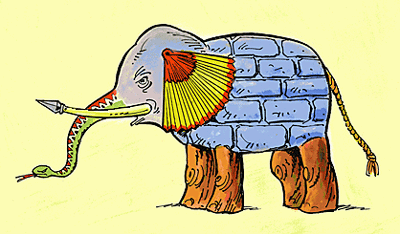
A meaningful definition of holistic must itself be holistic. The limitations of language make this impossible, but here are some clues.
Holism “The tendency in nature to form wholes that are greater than the sum of the parts through creative evolution.” Jan Smuts, who originated the term in his 1926 book Holism and EvolutionWholeness “An undivided or unbroken completeness or totality with nothing wanting.” The Free Dictionary.
Wholeness is all-encompassing, transcending the dualistic nature of mundane world, and cannot be reduced to parts. Neither can it be reduced to a pithy definition or distilled into an elegant concept.
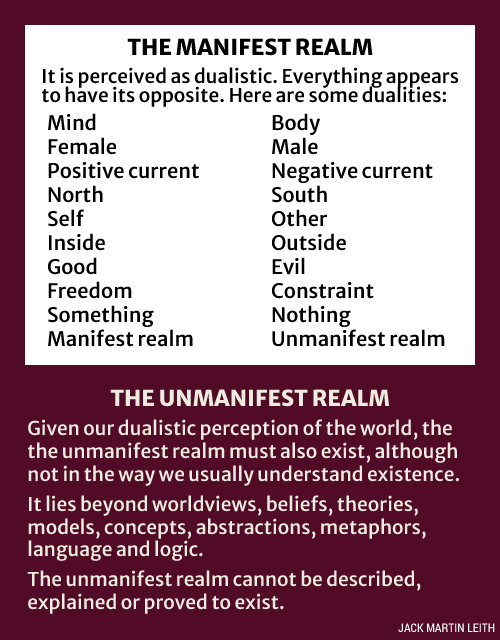
“Vedanta views reality as a wholeness, not divided into inner and outer domains as if they are separate kingdoms.”
Deepak Chopra, Will the “Real” Reality Please Stand Up?
Holism suggests that people are more than simply the sum of their parts. In order to understand how people think, holism suggests that you need to do more than simply focus on how each individual component functions in isolation. Instead, psychologists who take this approach believe that it is more important to look at how all the parts work together.”
Verywell Mind
Daniel Christian Wahl, From the ‘crisis of perception’ to the ‘systems view of life’
David Bohm, Wholeness and the Implicate Order
Not just what we think, but how we think. The change is:
 from abstract and symbolic conception…to acute and profound observation;
from metaphorical thinking…to original and direct inquiry;
from the habit of not looking freshly…to the discipline of finely tuned investigation; and
from reliance on concepts to bring a sense of order to the world…to an open quest to see what’s really there, even if it makes us feel uncomfortable, unsure, insecure, and mystified.
To make this shift, we must move from presuming to know before we look, to looking freshly without the limitation of a concept, metaphor, theory, or history of previous experiences.
Another way to say this is: start with nothing, e.g., without an idea of what we might find.”
Robert Fritz, in Reflections, The SoL Journal of Knowledge, Learning and Change, Vol. 5, Number 7 (no longer available online)
John Muir, wilderness explorer
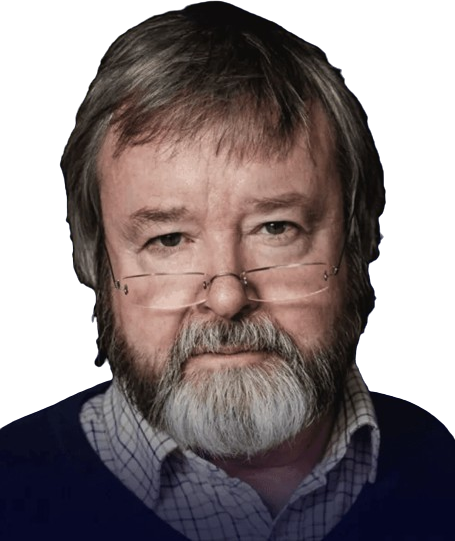
Iain McGilchrist
“System is illusory. All systems we fancy we observe in nature are merely constructions of the observer, and the ‘interconnected web’ or ‘system’ view of the universe is no more than a fairy tale.” Out beyond ideas of wrongdoing and rightdoing,
there is a field. I’ll meet you there.
When the soul lies down in that grass,
the world is too full to talk about.
Ideas, language, even the phrase each other
doesn’t make any sense.
Excerpted from A Great Wagon, by Rumi, Sufi mystic and poet, translated by Coleman Barks.
Daniel Christian Wahl, [6 Key Questions in] Whole Systems Thinking, an excerpt from this book, Designing Regenerative Cultures
The name that can be named is not the eternal Name.
The Nameless is the origin of Heaven and Earth;
The Named is the mother of all things.
Original source: Tao Te Ching (pdf), by Lau Tzu — aka Lauzi and other names — generally considered the founder of Taoism.
Susanne Cook-Greuter, The Construct-Aware Stage of Ego Development and its Relationship to the Fool Archetype (pdf) in Integral Review, August 2018. Vol. 14, No.1 (pdf) | The Construct-Aware stage corresponds with Turquoise in the image above
Explore further
Search the site
Not case sensitive. Do not to hit return.